Overview
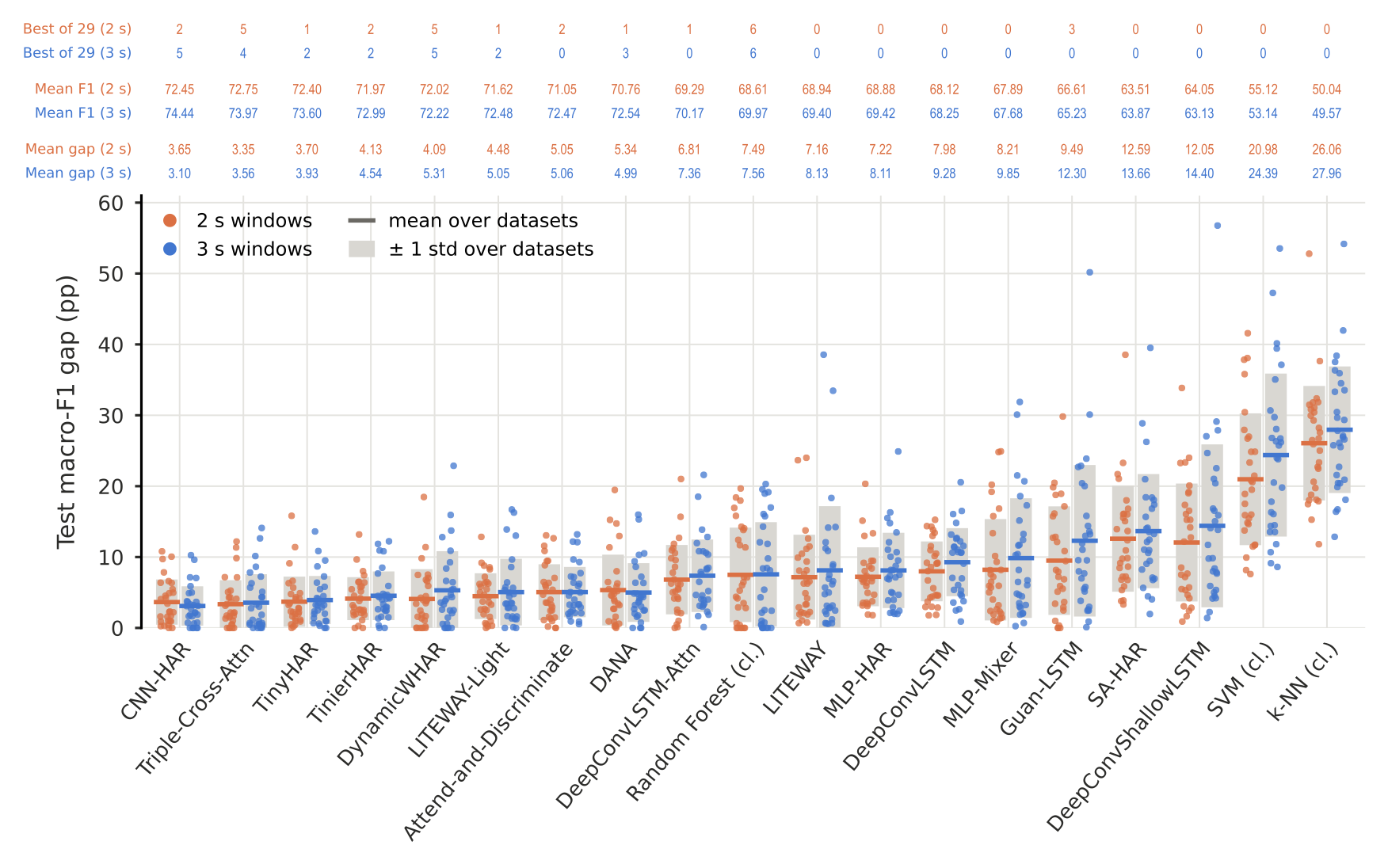
HARena is a living benchmark for sensor-based human activity recognition on edge devices, where models must balance accuracy against latency, memory and energy use. It has a public leaderboard, and new architectures and datasets can be added under one shared protocol. It targets a common weakness in the field: new models are usually compared against a few outdated baselines on a few datasets, each with its own data preparation and hardware. The first version evaluates 16 neural architectures and three classical baselines on 29 datasets. It measures accuracy on subjects the models never saw during training, and deployment cost on a smartphone, a smartwatch and a microcontroller. CNN-HAR, the oldest deep architecture in the set, has the best overall score, but eight architectures come within 2.5 points of it while their costs differ by orders of magnitude. On the microcontroller, Random Forest is best for latency and peak RAM, LITEWAY-Light needs the least flash storage, and TinyHAR is the most accurate model that still meets the real-time budget. Rankings change with the dataset and the number of sensor channels, so general claims need many datasets, which a growing benchmark can supply. The authors find no sign of benchmark overfitting. However, performance on unseen subjects drops by a median of 15 points, about three times the typical gap between architectures, which makes generalization and adaptation to new users the most promising directions for future work.